
Equifax has agreed to pay $575 million to settle consumer as well as state and federal regulatory claims for its 2017 data breach. This is the largest data breach settlement to date.
Continue Reading Equifax Reaches Historic $575 Million Settlement Agreement Arising from 2017 Data Breach
Texas Legislature Weighing Proposed New Privacy Laws
 Recently, legislators in Texas introduced two bills relating to consumer privacy and data protection: H.B. No. 4518, the Texas Consumer Privacy Act (“Texas CPA”) and H.B. No. 4390, the Texas Privacy Protection Act (“TPPA”). These bills bear a strong resemblance to the California Consumer Privacy Act (the “California CPA”), and would lay the groundwork for extensive administrative schemes protecting consumers’ rights to their personal information.
Texas CPA
The Texas CPA bears strong similarity to California CPA. The Texas CPA, which, if adopted, would take effect September 1, 2020, applies to companies that do business and collect consumer data and:
- Derive at least 50% of their annual revenue selling consumers’ personal information; or
- Exceed $25 million in gross annual revenue (with that amount subject to adjustment by the Texas Attorney General every two years); or
- Buy, sell, or receive the personal information of at least 50,000 consumers, households, or devices for commercial purposes
- The Texas CPA would also apply to entities owned by companies that would be subject to the law. Similar to the California CPA, the Texas CPA contains express provisions governing rulemaking, implementation, and enforcement of the law. Notably, the legislation highlights various consumer rights, including (but not limited to):
- A consumer’s right to disclosure, from the business, of the personal information the business collected.
- A consumer’s right to deletion of the personal information that the business collected (with some limited, specific exceptions).
- A consumer’s right to opt out of the sale of his or her personal information.
Continue Reading Texas Legislature Weighing Proposed New Privacy Laws
California Legislation Would Make CCPA Even Worse for Businesses
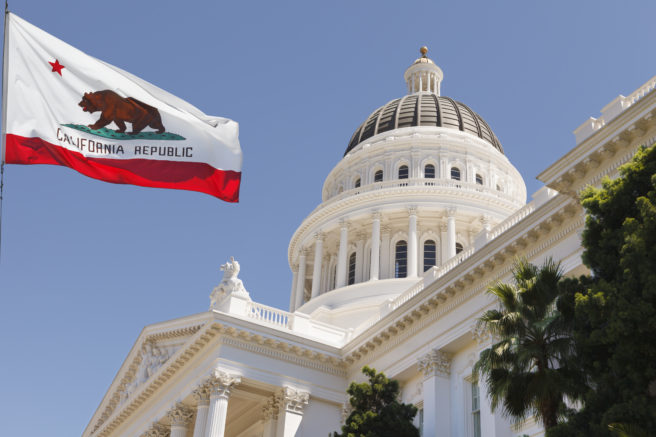 New proposed legislation in California, backed by state Attorney General (AG) Xavier Becerra, would amend the new California Consumer Privacy Act (CCPA) to make it easier for private plaintiffs and public officials to sue for violations while further increasing regulatory uncertainty and compliance costs for businesses. Specifically, SB 561 would expand the CCPA’s private right of action, remove the Act’s public enforcement “cure” provision, and eliminate the ability of affected companies to seek compliance guidance from the AG.
The CCPA is a sweeping new privacy law which goes into effect in January 2020. It gives California residents substantial control over personal data held by certain California businesses, requiring disclosure of what personal information the business collects, how that information is used or sold, and allowing consumers to control or delete that information upon request. It currently allows private plaintiffs to seek statutory damages of up to $750 per violation for certain violations, and it allows the AG to seek civil penalties of up to $2,500 for most violations, and up to $7,500 for violations found to be intentional.
Continue Reading California Legislation Would Make CCPA Even Worse for Businesses
CLE/Webinar: Colorado Cybersecurity Summit
 Ballard Spahr’s Privacy and Data Security Group will again be hosting its Colorado Cybersecurity Summit on September 18, 2018, at Ballard Spahr’s Denver office and via webinar.
Highlights will include a discussion with the Colorado Deputy Attorney General who will be responsible for enforcing Colorado’s groundbreaking new cybersecurity law, as well as the former Director
Alabama Becomes 50th State to Enact Data Breach Notification Law
 Alabama has officially joined the data breach notification party. Alabama Governor Kay Ivey signed Act No. 2018-396 into law on March 28, 2018. The law will take effect on June 1, 2018. Although it was last in the country to enact such a data security law, Alabama’s new law will immediately take its place among the most stringent in the nation.
The Alabama law generally can be categorized into four obligations:
- All entities subject to the law (covered entities and third-party agents) must “implement and maintain reasonable security measures to protect sensitive personally identifying information against a breach of security.”
- A “covered entity shall conduct a good faith and prompt investigation” into “a breach of security that has or may have occurred in relation to sensitive personally identifying information.”
- A covered entity must notify each affected Alabama resident, and a third-party agent must notify the covered entity, of a “breach of security involving sensitive personally identifying information;”
- A covered entity must notify the Alabama Attorney General and credit reporting agencies of a breach involving more than 1,000 Alabama residents.
Continue Reading Alabama Becomes 50th State to Enact Data Breach Notification Law
South Dakota Enacts Data Breach Notification Law
 South Dakota (site of Ballard’s newest office) has become the 49th State to enact a data breach notification law. South Dakota Governor Dennis Daugaard signed SB 62 into law on March 21, 2018. The law will take effect on July 1, 2018.
As with similar measures pending in other state legislatures, SB 62 was introduced in the South Dakota Senate on January 9, 2018, in the wake of the disclosures relating to the Equifax breaches. The law generally mirrors those of many other states, but includes a few new wrinkles.
Continue Reading South Dakota Enacts Data Breach Notification Law

Massachusetts Attorney General Launches Online Data Breach Reporting Portal
Massachusetts Attorney General Maura Healey has unveiled a new, “easier and more efficient” way to notify her office of data breaches. The Massachusetts Attorney General’s Office has created an online portal and web form for submitting data breach notifications. An email announcing the changes was transmitted this week to attorneys who have previously filed data breach notices on behalf of clients. The email requested our “assistance in passing the message along,” which we are hereby doing.
Attorney General Healey stated, “This new feature allows businesses to more efficiently report data breaches so we can take action and share information with the public.” The Attorney General Office’s website will soon include a publicly accessible database of data breaches reported to the Office. Other states, including California and Maryland, have similar public databases.
Continue Reading Massachusetts Attorney General Launches Online Data Breach Reporting Portal
South Dakota and North Carolina Consider New Data Security Legislation

Add South Dakota (site of Ballard’s newest office) and North Carolina to the list of states considering new data security legislation. South Dakota is poised to become the 49th state to enact a data breach notification law, while North Carolina is considering a very significant expansion of its existing law.
Will South Dakota Become No. 49?
The South Dakota Senate passed SB 62 on January 25, 2018. The bill, which now heads to the South Dakota House of Representatives, generally would require an “information holder” to notify South Dakota residents of any “breach of system security” involving their “personal or protected information.” Subject to certain exceptions, notification to South Dakota residents must be made “not later than sixty days from the discovery or notification of the breach of system security.” The South Dakota Attorney General and “all consumer reporting agencies as defined in 15 U.S.C. § 1681a” also must be notified of breaches involving more than 250 South Dakota residents. Notification to South Dakota residents is not required “if following appropriate investigation and notice to the attorney general, the information holder reasonably determines that the breach will not likely result in harm to the affected person.”
Continue Reading South Dakota and North Carolina Consider New Data Security Legislation
New 2018 Data Breach Compliance Obligations Begin Going into Effect
 With the New Year comes new data breach compliance obligations! Two Mid-Atlantic states have cybersecurity related compliance statutes that have – or will soon – take effect. Are you ready?
New Year’s Day ushered into effect the amended Maryland Personal Information Protection Act, which expands the definition of “personal information,” creates a 45-day deadline for providing notice of a breach, allows for substitute service when the breach enables an individual’s e-mail to be accessed, and increases the class of information subject to Maryland’s destruction of records laws. To the customary litany of data elements comprising “personal information,” Maryland has added personal health and health insurance information, biometric data, online account credentials and passport/government ID numbers. The amended data destruction provision now applies to customer and employee/former employee records containing personal information. See our prior alert detailing the amendments here.
Continue Reading New 2018 Data Breach Compliance Obligations Begin Going into Effect